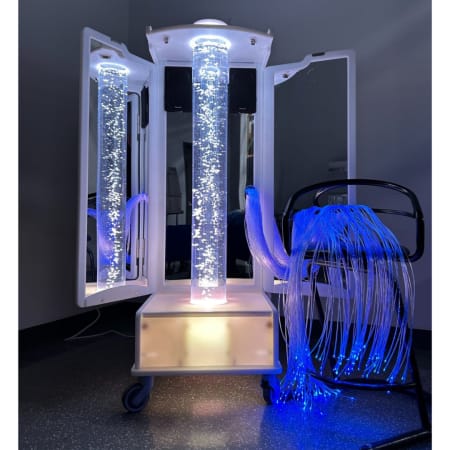
Studies in pediatric emergency departments have shown that sensory tools and sensory-adapted approaches are perceived by caregivers as helpful in reducing distress for children with autism during ED visits. Caregivers and clinicians reported improved patient experience when sensory supports were available.
Sensory items such as weighted tools, calming visual supports, and tactile objects have been implemented in pediatric emergency settings to help patients regulate sensory input and remain calm during procedures and assessments.
Research indicates that sensory supports not only benefit patients but also improve interactions between families and clinical staff. Caregivers reported that sensory toolkits facilitated their ED visit, and healthcare providers noted smoother engagement.
Studies on sensory-adapted healthcare spaces show that addressing sensory sensitivities can reduce overstimulation and improve participation and coping during medical visits, including waiting periods.
Multi-sensory environments are increasingly recognized as a non-pharmacological calming intervention within hospital settings. Canadian research in acute psychiatric care has described sensory modulation rooms as an alternative to restrictive practices, including physical restraint and PRN (as-needed) medication.
While outcomes may vary by setting, sensory-adapted environments are positioned as supportive tools that may help reduce behavioural escalation intensity, support patient self-regulation, and decrease reliance on invasive interventions.
For Emergency Departments, integrating multi-sensory tools aligns with restraint-minimization frameworks, patient safety initiatives, and trauma-informed care strategies aimed at reducing the need for pharmacological sedation and physical containment whenever clinically appropriate.
Qualitative research exploring sensory-adapted emergency environments highlights that parents and healthcare professionals value sensory-friendly spaces as part of trauma-informed and patient-centered care.
Emergency Department waiting rooms are often bright, noisy, and unpredictable environments. Research examining sensory-adapted healthcare spaces in Canada highlights that overstimulation in clinical environments can increase anxiety, agitation, and distress—particularly for pediatric patients and individuals with sensory sensitivities.
Providing access to calming lighting features, portable visual focus tools, pediatric sensory stations, and dedicated quiet zones can help reduce environmental triggers while patients and families wait for care. These sensory-informed adaptations align with patient-centred and trauma-informed design principles, supporting improved emotional regulation and family comfort during extended wait times.
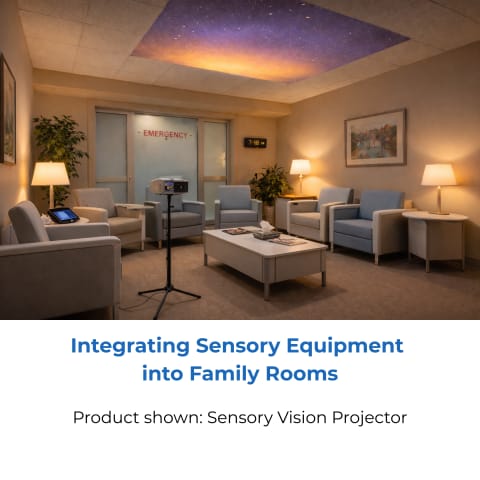

Emergency Departments regularly care for patients experiencing acute stress, pain, trauma, behavioural escalation, or sensory overload. For pediatric patients, individuals with ASD, dementia, developmental disabilities, or mental health crises, the ED environment can intensify anxiety and dysregulation.
Multi-sensory therapy introduces controlled light, movement, and tactile input to create calming moments within an otherwise overstimulating setting. These tools support:
Multi-sensory therapy is increasingly recognized in Canadian hospital settings as a key component of patient-experience strategies. Sensory environments — whether permanent rooms or portable tools — create calming spaces that help patients feel comforted, supported, and neurologically regulated during stressful interactions with the healthcare system, contributing to a more humanized emergency care experience.
In pediatric emergency settings, sensory tools can reduce fear during IV starts, imaging, suturing, and monitoring. In mental health and behavioural presentations, they can support stabilization without physical restraint.
Reduce anxiety and agitation during triage and treatment
Support non-pharmacological calming strategies
Improve patient cooperation during procedures
Assist with de-escalation in behavioural health presentations
Enhance trauma-informed care practices
Support smoother re-entry to waiting areas after distress


Our medical-grade equipment is manufactured in Canada, designed to be used throughout hospital units.
We offer consultative and installation services to ensure your sensory equipment and spaces succeed your expectations.
Citations
Pediatric emergency department quality improvement study on sensory toolkits for autistic children.
https://pmc.ncbi.nlm.nih.gov/articles/PMC11261820/
Pediatric emergency sensory supports and autism care guidance.
https://academic.oup.com/pch/article/29/4/199/7633894
Qualitative research on sensory-adapted emergency environments.
https://www.preprints.org/manuscript/202509.0163
Sensory-adapted healthcare environments and pediatric outcomes.
https://www.frontiersin.org/articles/10.3389/fped.2024.1427433/full
Sensory modulation rooms as alternatives to restrictive practices in acute psychiatric hospital settings.
https://pmc.ncbi.nlm.nih.gov/articles/PMC6874072/
Study examining sensory overload and the impact of sensory-adapted healthcare environments in pediatric settings, supporting reduced anxiety and improved patient experience in waiting areas.
https://www.frontiersin.org/journals/pediatrics/articles/10.3389/fped.2024.1427433/full